
Most drivers treat a license plate as a random string. It rarely is. Behind nearly every national registration system sits a logic that encodes region, age, vehicle class, or all three at once. Once you learn to spot the pattern, a parking lot in a foreign city turns into something you can actually read.
Here is a practical guide to the structures that cover most of the vehicles you are likely to encounter.
Regional codes at the front
Germany is the clearest example. A German plate opens with one to three letters identifying the registration district, followed by a seal, then one or two letters and up to four digits. B is Berlin, M is Munich, K is Cologne, HH is Hamburg. Smaller districts get longer codes, so a three-letter prefix usually means a rural county rather than a major city.
Austria, Poland, Hungary, and several others use variations of the same idea. Russia places a region number on the right side of the plate instead of the front. Spain abandoned provincial codes in 2000 and went national, which is why an older Spanish plate starting with M or B tells you something a newer one does not.
For a buyer, a regional code is a data point. A car from a coastal district has probably lived with salt air. A car from an alpine county has probably seen road salt and steep grades. Neither is disqualifying, but both are worth a closer look underneath.
Age identifiers in the middle
The United Kingdom builds the vehicle’s age directly into the number. Since 2001 the format has been two letters, two digits, three letters. The two digits are the age identifier, and they change twice a year. A plate reading 24 means the car was first registered between March and August 2024. A plate reading 74 means September 2024 through February 2025. The second half of the year adds 50 to the base number.
This is unusually useful. It means you cannot misrepresent a British car’s model year without changing the plate, and the plate is on the V5C registration document. Ireland goes further and spells out the year and half-year explicitly, followed by a county code.
Vehicle class encoded by color
Color carries meaning in many systems.
The Netherlands uses yellow plates front and rear for ordinary vehicles, which makes Dutch cars instantly recognizable on any European motorway. India uses white plates for private vehicles, yellow for commercial, green for electric, and red for temporary registration. In much of Europe, a red band or red characters indicates a temporary or export registration with an expiry date printed on the plate itself.
Several countries reserve separate series for diplomatic corps, military, police, and government fleets. These are usually visually distinct, and vehicles carrying them are generally not available on the open market.
The North American exception
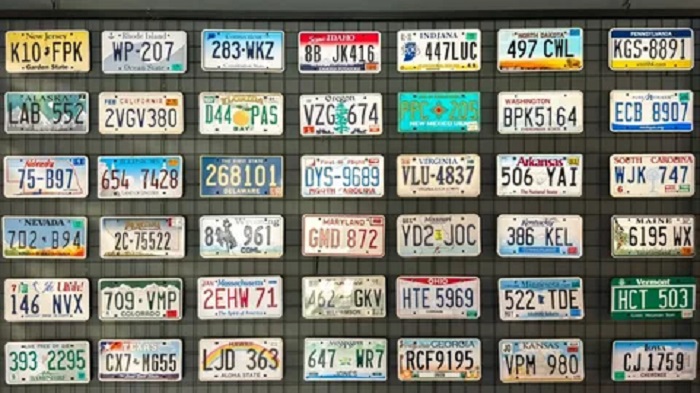
The United States and Canada work differently from almost everywhere else. Each state or province designs its own plate, sets its own format, and controls its own issuance. There is no national sequence and no universal age or region encoding. What you get instead is a graphic design competition, with slogans, landscapes, and specialty series numbering in the hundreds in some states.
The practical consequence is that a US plate tells you the issuing state and very little else. Vehicle history has to come from the VIN and the title record rather than from the plate itself.
Anyone comparing systems across borders will find that mapping these differences by hand is tedious work, which is why reference projects like GlobalLicensePlates exist to collect formats, codes, and design histories country by country.
Three checks worth running on any plate
Does the format match the claimed country and era? Formats change. A Spanish plate with a provincial prefix cannot have been issued after 2000. An Italian plate with a province code in the main sequence predates 1994.
Does the physical plate match the paperwork? Font, spacing, and seal placement are standardized in most countries. Irregular character spacing is a common sign of tampering.
Does the region code make sense with the story? A seller claiming a car spent its life in one city should not be holding a registration from three regions away without an explanation.
None of these replace a proper history check. All three take under a minute, and they catch the obvious problems before you spend money on the non-obvious ones.
Why bother
Plate literacy is a small skill with an outsized return. It helps when buying abroad, when renting in an unfamiliar country, when assessing a car whose history seems too clean, and when you simply want to know why the car ahead of you at the border has a red stripe down the side of its number.
Cars carry their paperwork on the outside. It is worth learning to read it.